What has God revealed to me so far through my prayer and life experience?
I am ambivalent about writing these words, who am I to do so? We each have unique insights to share with others. I have a friend who can tell what’s wrong with the engine of a car simply by listening to it. I can’t do that. Others have special insights that make them good teachers, healers, cooks, gardeners, parents, sportsmen & women, etc. These are their vocations, and we each have a number of them.
One of mine has been a life-long search for God, in response to which God has revealed things to me. I am not especially good at articulating what I’ve been shown indeed I’m aware of many who write better and with greater wisdom & insight than I do; and I equally know many people who have far more faith than I do. I have done nothing to deserve knowing what I have learnt: it’s all been unwarranted gift. But the Message is more important than the messenger and for that reason I need to try and share it with any who are interested, while recognising that God might have revealed different insights to you.
These words have been brewing for a very long time, but my 80th birthday initiated a good deal of personal reflection on my life. I can now see more clearly my spiritual journey’s path. My reflections have also been helped in the past weeks by reading ‘The Great Search’ by John Philip Newell where the words of other people have helped me name what I already knew but hadn’t yet found words for. I cannot commend it too strongly.
Such spiritual wisdom as I process is based on my personal experience not in statements of faith,
1 There is a divine spark in each of us, our soul: that part of us that longs for connection with the divine, and for meaning & purpose in our lives. There are moments when we become aware of the existence of that connection with the immanent and transcendent God. Martin Buber talks about them as “I—Thou” moments: when we know ourselves to be in relationship with Another.
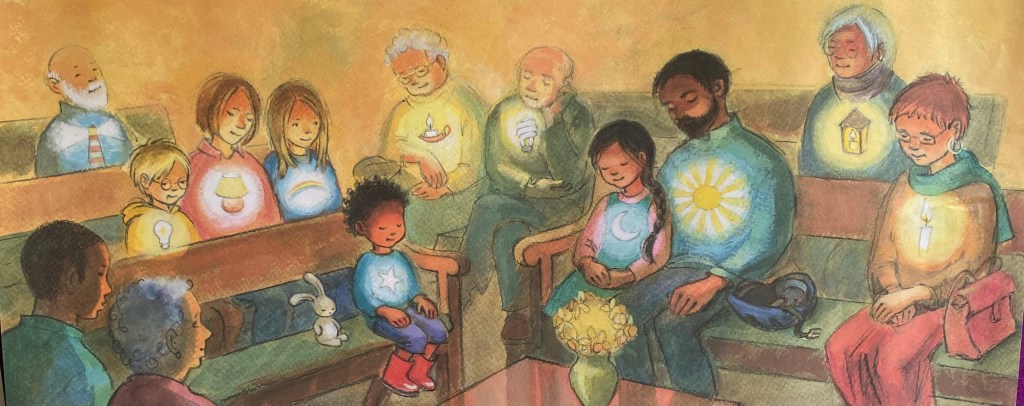
An image of a mixed group of people in a Quaker meeting, each with a symbol of the immanent God within them.
They come unsummoned, like the wind it blows but we don’t know where it comes from or where it is going. We cannot control it. But we can learn to be open to it, recognise it, and trust it. Then it will change and guide us. “Let your soul be your pilot” It nourishes us and brings us alive and we become people of faith, even if we are unbelievers, because we are being faithful and responding to the Divine spark within us, our soul. God has shown me that I can trust the wisdom it teaches.
2 Moments of spiritual insight can come to us in many different ways:
[a]] They can come in fleeting moments of connection with another person: simple eye connect in a fleeting encounter; in conversations and shared experiences at depth with another person; on reading a book or poem, listening to a piece of music, looking at a work of art; in finding oneself loved and loving; in dreams and visions; in intuitive knowings; through synchronicity and serendipity. They are not limited to individual experience but can also come in times of collective awareness, when we share in an experience with others.
[b] My life was turned upside down by an unexpected experience of being ‘spoken to’ by God in a time of crisis. The words were of affirmation and support which touched something deep within me with an authority and authenticity I couldn’t doubt. I had never experienced anything like it: they changed me. I knew that I had to set them at the centre of my life and seek to live out of them. I knew that I would not be able to do that as a parish priest, which I then was.
Research led by Alister Hardy in the 1960s led to the conclusion that about half the adult
population of Britain would claim to have a spirituality that is grounded on their personal
experience. [A survey conducted in 2000 suggested that slightly more than 76% of the national
population are now likely to admit to having had a spiritual or religious experience.] In-depth work where there was time to build up trust repeatedly showed that approximately two thirds of those interviewed were prepared to acknowledge and talk about their spirituality. They typically speak of one of the outcomes of their experience as an increasing desire to care for those close to them as well as a sense of responsibility for the larger community and the physical environment.
This is ‘The God you already know’ of Whom Roy Gregory and I wrote. If there is truth in this then the Church has its mission strategy wrong. It assumes that it has knowledge of God that others lack & need to be told about. The opposite appears to be true: that most people already have some experience of God, which doesn’t fit easily with what the Church teaches.
[c] I’ve had a number of similar experiences since, as well as several in which I knew myself to be ‘spoken to’ by people whom I knew to be dead. The first occasion was ‘Damascus Road like’. It shook me rigid. Like the experiences above these too changed me, not least because they took away my anxiety about death and replaced it with a deep confidence that death is not the end.
[d] They can come in moments of revelation in the natural world. I remember going outside into his garden to pray in the middle of the night with my friend Adrian. The silence & stillness was profound, and it felt as if the stones, plants and trees in the garden were all in their way praying too, and that he & I were united with all of creation, including the stars, in prayer and worship. I still from time to time sit outside in the dark and open myself to the same thing.
I’ve taken recently to lying down on the earth and either closing my eyes or gazing up at the sky, simply watching the clouds moving slowly above me, while the earth beneath holds me to itself.
I remember sitting by a river and being suddenly surprised when three otters, one after the other, popped up out of the water & looked at me as I looked at them. I felt richly blessed. Cats and dogs have an intuitive knack of knowing how we are feeling. I know of several people who when feeling very alone & even perhaps abandoned by God, found that their cat was unexpectedly curled up next to them.
Thomas Berry wrote that “every species is a unique revelation of the Divine’ and that must be true. The Bible testifies that God is able to ‘speak’ to us through absolutely anything. The world is a place of enchantment, in which animals are often angels [aka ‘messengers from God’]
3 We are born seeking relationships with others and Another, without which we will not survive. Many of the things that give value to life are based on relationships: love, security, sexuality, goodness, healing, hospitality, generosity, kindness, friendship, music, laughter, justice. Others are based on our search for Another: curiosity, creativity, vision, awe, wonder. Others reflect memories of whence we came: beauty, truth and peace.
All people seem to be aware of these things, although they are expressed variously at different times & in different cultures. They’re not easy to define in words, but you recognise them when you see them. How do we explain this? I sense that they are memories that we are born with.
John’s Gospel talks of Jesus having come from God before His birth & of returning to God at His death. I assume that if this is true of Jesus then its true for all human beings & that we all bring with us at birth some ‘Memories of the Home’ from which we’ve come and to which we’ll return when we die. Not surprisingly they make life meaningful, as well as shaping our expectation of whatever lies beyond death, of what ‘paradise’ is like.
I remember as a young child having a strong sense that I came originally from somewhere else, and I suspect that that’s not an uncommon experience
4 When the Gospels talk about faith they mean ‘trust’. People came to Jesus because they trusted Him, and He could do nothing if they didn’t. He never sought a credal statement from someone seeking His help.
Faith as ‘trust’ arises out of a relationship, faith as a credal statement is based upon rational understanding. Faith as trust deepens our relationship with God. Faith as understanding objectifies God as something apart from us that needs to be understood. We need to get back to Jesus’ understanding of faith.
Trusting God means accepting what life brings. As the saying puts it “God shelters us from nothing but sustains us in everything.”
5 After His baptism Jesus had a life changing experience of being ‘spoken to’ by God. He ‘heard’ God say to Him “You are my beloved son in whom I am well pleased.” It must have shaken him to his core & He took Himself into the wilderness to reflect on it. Could He trust what he’d heard? If so what did it mean? How should He respond?
He decided that He couldn’t but trust it. He knew that if God felt like that about Him then God presumably felt like that about everybody: all people are loved by God as God’s sons and daughters. That was a very different understanding of God from what He’d been brought up with: it changed everything.
How could He share it with others who hadn’t had that experience? He appears to have decided that He had on the one hand to speak about this “Good News’ and on the other to start treating people as if what God had said was true. He had to ‘incarnate’ the message in His dealings with people. And that is what he did. He spoke and acted out of His being a beloved son of a loving God, to men and women whom God equally loved, unconditionally.
6 Our call is to do likewise, to follow in Jesus’ way, by heeding our spiritual experience & trusting that God will open a way for us. It is less a matter of thinking that Jesus has done something for us, rather, seeing that Jesus has shown us the way for us to follow. We have inevitably put Jesus on a pedestal, and I’m not saying that is a mistake, but it becomes a distraction if it leads us to assume that Jesus has done it all for us and we just need to believe it and we will be saved.
7 My ministry in spiritual conversations [aka spiritual direction] has shown me that most people already know most of what they need to know about God, & what the ‘spiritual life’ entails. But the knowing frequently lies hidden, buried treasure within them, forgotten, and not trusted. It requires re-discovery, re-evaluating & often the letting go of what has been previously taught or learnt.
8 The other mark of a ‘faithful unbeliever’ of course is the presence of Love. I give it a capital letter to denote its divine origin, but its present in the immanent God within each of us. We’re not likely to be able to match the unconditional love of God, although we might try & sometimes come close. But despite what the newspapers might tell us, there is an enormous amount of love being shown in our world on a daily basis, most of it hidden and unremarked upon. I’m talking about the love of parents for their children, love shown to those who are sick or handicapped in some way, the love shown to refugees, by those who visit family members with dementia…..the list is endless, and it includes those of all the faith traditions and those of none. In loving and being loved we are faithful followers of Jesus.
9 All faiths are manifestation of that universal divine spark in all, and in everything. It is expressed in different ways in different times and in different cultures: there is a richness and variety in its modes of expression, reflecting the richness and immensity of God. But they are common paths up the same mountain. There is no competition. We need to learn from each other. It is a message that the world urgently needs.

 A CONTEMPORARY SPIRITUALITY
Leave a reply to priestworker Cancel reply