
June2021
I marked Easter this year by mulling on the Resurrection stories in the Gospels, and found myself led from those in John’s Gospel to John’s account of the raising of Lazarus, where I was struck by both the similarities and the differences between the stories of Jesus’ Resurrection and that of Lazarus.
We see a painting of the Raising of Lazarus by Rembrandt. Jesus is shown standing above a tomb from which Lazarus is emerging. Jesus’ right hand is raised, and His mouth is open. Lazarus’ two sisters and others look on.
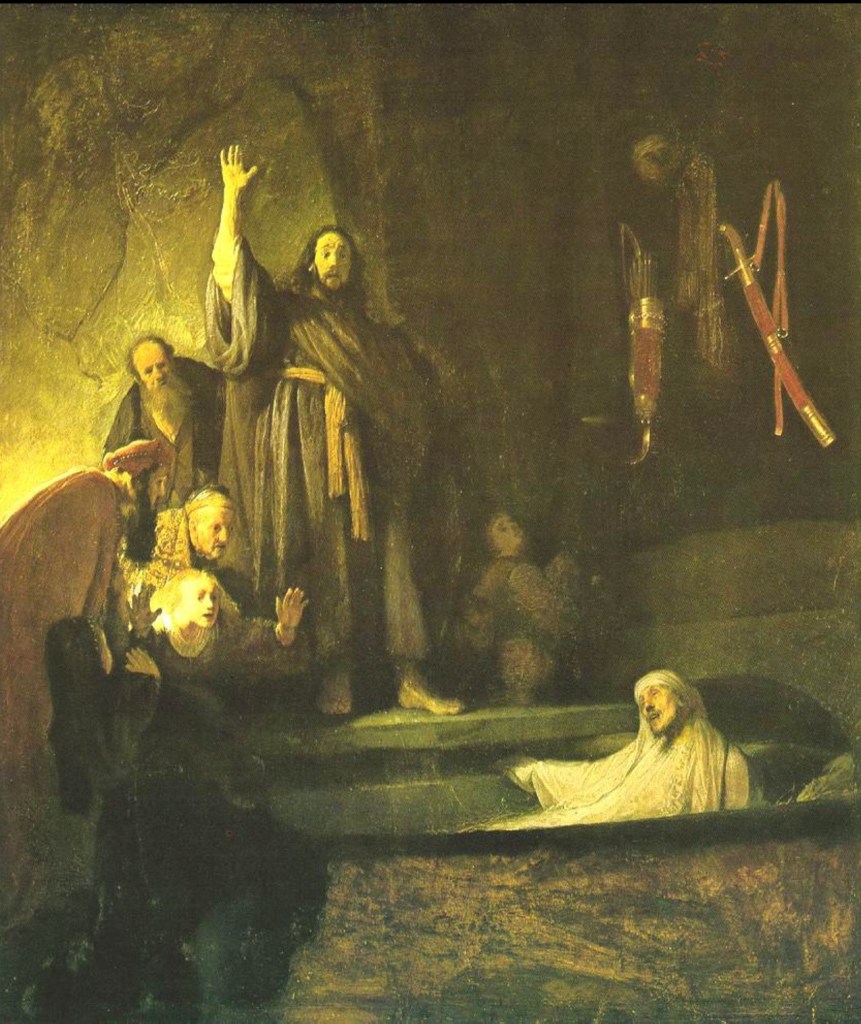
In the story of Lazarus, Martha and Mary arrive at their brothers tomb with a crowd of witnesses. Lazarus’ body has been there for four days. Jesus commands that the stone in front of Lazarus’ tomb be taken away. Martha is concerned at the probable stench from Lazarus’s decomposing body, but nevertheless the stone is removed. Jesus commands Lazarus to “come out” and he does, still wrapped in his grave clothes. Jesus tells the onlookers to “Loose him, let him go,” and as a result many of them place their faith in Jesus. The story says nothing more of Lazarus save that later when Mary & Martha give a supper at home in honour of Jesus [not Lazarus!], their brother Lazarus is amongst the guests. Throughout the story the focus is on Jesus not Lazarus.
In John’s story of Jesus’ Resurrection on the other hand, women visit the tomb where they had seen his body interred and find the stone covering the grave moved, the tomb empty, and Jesus’s grave clothes folded neatly to one side. There is no sign of Jesus body and no mention of a smell. It’s as if Jesus body was never there and yet they knew that it had been. There are no witnesses as to what has happened.
There is common ground in that both men died and their bodies were placed in tombs that were then sealed with a large stone. But the differences are considerable: Lazarus dead body was seen to be still in his tomb, and it stank, witnesses saw Jesus bring him back life, and life then continued as before for Lazarus. Jesus body had been in his tomb but then wasn’t, there were no witnesses as to what had happened, and later some of His followers claimed that He had appeared to them in various ways, such that they were convinced that He was alive, although not in quite the way He had been before.
It’s as if John is spelling out that Jesus’ resurrection was of an entirely different order from that of Lazarus who while physically restored, will still die one day. John is not concerned with Jesus being physically restored but with the fact that He restored his followers, filling them with confidence and hope, and then commissioned them to continue the ministry that he had begun, under the guidance of His continuing presence.
 A CONTEMPORARY SPIRITUALITY
Leave a comment